


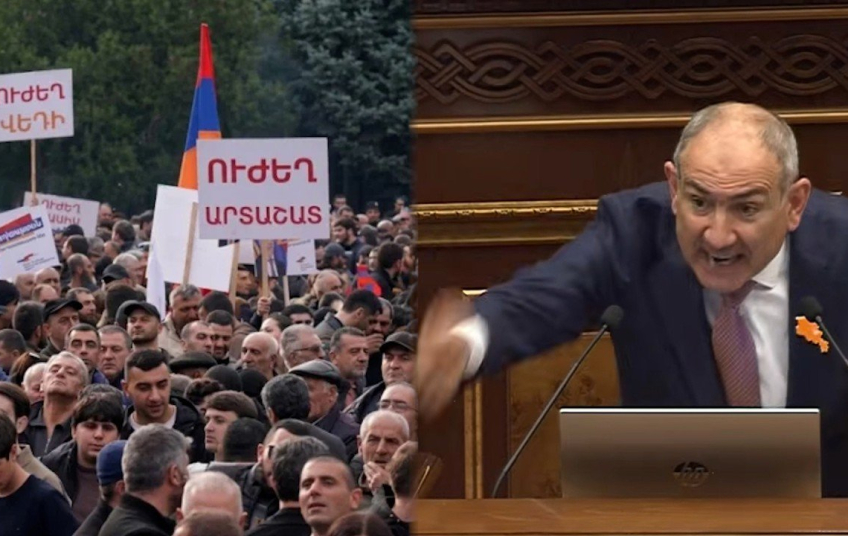

What the person occupying the prime minister’s chair declared from the country’s main podium on April 16 can hardly be described as anything other than the height of impudence. During the National Assembly session on the implementation of the 2025 Government Program (2021–2026) of the Republic of Armenia, Pashinyan was in his element—tense, enraged, embittered with the world, bursting into fits of shouting, and using street-level vocabulary. This time, he “went after” the main opposition forces that had nominated a candidate for prime minister, as well as the citizens preparing to vote for them in the June 7, 2026, parliamentary elections, calling them “the rabble” (“the rabble,” a folk expression for a group of people perceived as disreputable or undesirable—Ed.).
Pashinyan does not believe, or does not want to believe, that there will be enough of this “rabble” in Armenia for the political forces of the “three-headed party” (referring to the Hayastan Alliance; the Strong Armenia Party; and Prosperous Armenia Party) to enter parliament. Moreover, he sees the meaning of the upcoming political processes as citizens standing up for peace and consistently sending the “rabble” of the former “three-headed party”—the political “bosha”—out of politics (“bosha” refers to Armenian-speaking Christian Roma who appeared in the Armenian Highlands in the 11th–12th centuries; figuratively, it is used as a synonym for a shameless or brazen person—Ed.).
As we can see, the insulting labels “the rabble” and “bosha” are being cleverly redirected from citizens toward opposition leaders. Apparently, somewhat belatedly, he realizes that insulting his own voters means sawing off the branch he is sitting on. It is better to redirect the danger toward rival candidates, as he is used to it, after all, always shifting his mistakes and missteps onto others, whoever they may be, even Russian president Vladimir Putin, whom he once tried to accuse of handing over Nagorno-Karabakh to Azerbaijan. Now, taking advantage of the moment, he has decided to target the trio of opposition rivals from the National Assembly podium, those he fears the most at this point.
And fear, as a rule, can drive him to psychological instability. We saw this at the same National Assembly session on April 16, when Pashinyan engaged in a virtual fight with opposition leaders: “Apart from being the rabble, you cannot have any other status… who are you, anyway? I’m saying this to the three-headed, four-headed parties of war, plus the blasphemous “ktrich”s (brave ones)—who are you, anyway, what do you represent… we are a very effective government; we have pulled the country out of the trap, the trap we entered with the Karabakh movement and in which the three-headed war parties and their satellites have constantly pushed us and kept us.”
It is no secret that Pashinyan is a controversial figure and, judging by his speech, unstable mental state, and peculiarities of behavior, suffers from a split personality, the symptoms of which are evident. These include lying, a sharp contradiction between words and actions, irresponsibility, and so on. According to specialists, people are generally not born with split personality disorders; it is the result of some psychological trauma experienced in childhood. The stronger the trauma, the more severe the consequences. In Nikol’s case, the most severe consequence is the absence of a sense of statehood, its complete absence.
If a person holding the position of prime minister of a country sees his responsible mission at the level of “rabble” quarrels or cheap verbal sparring with opposition forces, then he is, willingly or unwillingly, admitting his own fears, weakness, and incompetence, if not outright doom. It is dangerous to entrust the leadership of the state to such a lame duck who has exhausted public trust. Or perhaps Pashinyan is looking for a way to rid himself of the increasingly unbearable burden of power? In any case, leaving such a miscreant at the helm means condemning him to destruction and along with him, Armenia as well.
“Hayatsk Yerevanits” Journal