


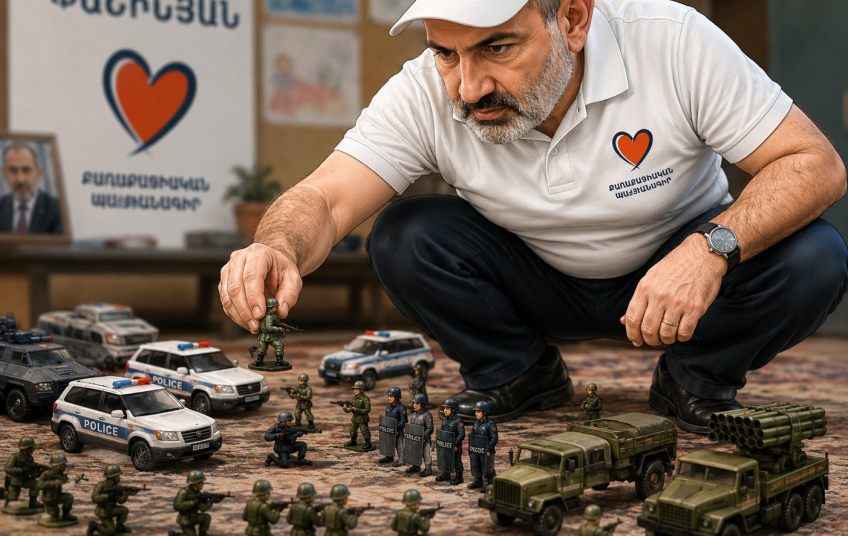

As part of the election campaign, unprecedented and deeply shameful events are taking place in Armenia, with the central figure being, however unbelievable it may seem, the incumbent authorities themselves, embodied by Nikol Pashinyan, who occupies the office of prime minister. In other words, the head of government, instead of upholding and safeguarding the reputation, honor, and dignity of the country entrusted to him, is personally tarnishing its good name and sacrificing it for the sake of personal interests. The immediate occasion is the parliamentary elections scheduled for next week and his apparent determination to secure a third term in power. As a result, there is a significant likelihood that the elections may be manipulated or falsified.
However, if one examines the situation more closely, the process of rigging the June 7 parliamentary elections began long ago, at least as early as May 8. In this context, the assurances given by relevant international organizations and election-monitoring bodies that everything is in order regarding Armenia’s upcoming elections are not convincing. In reality, the facts point in the opposite direction: the authorities have extensively deployed administrative resources, something we witness daily during the campaign, including instances where people, schoolchildren among them, are transported by bus to rallies of the Civil Contract Party.
The party that naturally controls the situation is the ruling political force, which is served unquestioningly by the entire apparatus of the state, with its legal, ideological-political, and security instruments. Meanwhile, Pashinyan’s “pocket” law-enforcement system is being used as a punitive tool against the opposition. The detention facilities of Armenia’s Investigative Committee have never been so overcrowded under any previous leadership. Anyone who has, willingly or unwillingly, stood in his way, who has obstructed, criticized, or opposed him in any manner, has been sent behind bars, regardless of their innocence or the absence of any criminal wrongdoing.
Let us cite two recent examples. On May 21, it became known that Arthur Osipyan, a Karabakh Armenian politician and former lecturer at Artsakh University, had been detained two days earlier after an argument with Pashinyan during a Civil Contract campaign event in the Arabkir district. He was subsequently remanded in custody for two months and went on a hunger strike while in detention. The dispute erupted after Osipyan reminded the Civil Contract leader that, regarding Nagorno-Karabakh, he had faced a choice between two options: to stand with the people or to side with the so-called “Karabakh clan,” and that he had chosen the latter, which he had regularly financed. Nikol lost his temper and began hurling insults at the young man who had lost both his homeland and his property as a result of these policies, shouting: “Hey, you scumbag, explain to me, why didn’t you die? Why didn’t you die in a trench somewhere, you deserter... I’m telling all of you, sit down and stay in your places...”
As a result, the intellectual who had initiated a civil and substantive debate ended up in prison, while the would-be prime minister who had hurled personal insults and threats remained unpunished. The next person to be unlawfully detained was Andranik Tevanyan, the second candidate on the Prosperous Armenia Party electoral list. First, Pashinyan accused him, and then the National Security Service (NSS) “confirmed” allegations of espionage and treason in favor of Russia. “This is absurd. Nikol Pashinyan, I have already explained what kind of ‘treason’ I have supposedly committed. You will not succeed in accusing me of such a crime. But we are going to present very specific accusations against you regarding how you surrendered Artsakh and what you received in return,” Tevanyan responded.
Pashinyan can ruin a person’s fate over the most trivial matter—of course, not without the help of the numerous security officials surrounding him, who serve as his instruments: tactless, emotionless, and inhumane. For them (including Nikol himself), it makes no difference who the next victim will be, regardless of gender, age, citizenship, social status, occupation, or any other characteristic. There is no forgiveness and no mercy. The only mitigating factor is personal loyalty to the man holding the prime minister’s chair. Pashinyan’s instruments are not only the security forces but also members of the government, deputies of the Civil Contract faction, and, in short, everyone he can dismiss from office with a single SMS message.
“Hayatsk Yerevanits” Journal