


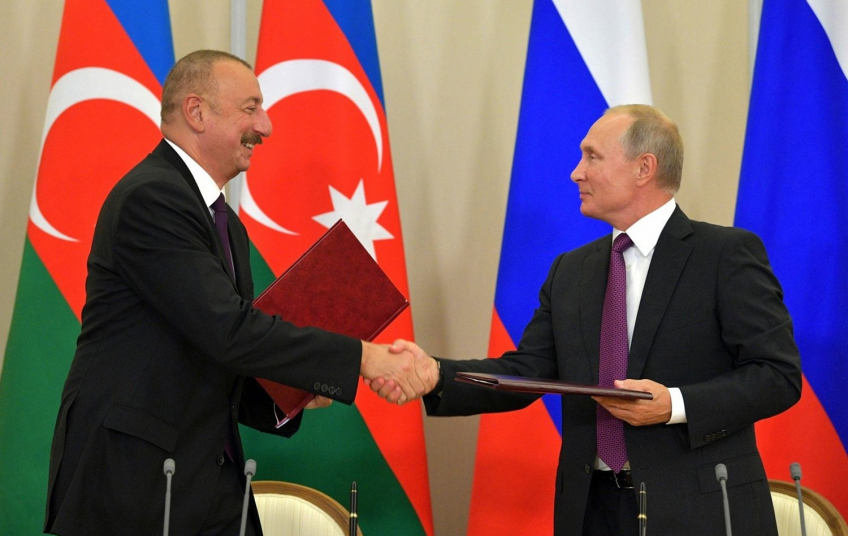

Against the backdrop of the Russia-Ukraine crisis escalation, a rather interesting event in Moscow on February 22 seems to have gone unnoticed: the Presidents of the Russian Federation and the Republic of Azerbaijan signed a Declaration on allied interaction between the two countries, which according to Aliyev, would "raise the mutual relations between official Moscow and Baku to a qualitatively new level of allied relations." In a conversation with Russian media, Aliyev proudly noted that the stated format of relations was the highest: “In other words, there is practically nothing higher than in interstate relations, this is the tip of the iceberg, so to speak." He reminded that the declaration on allied cooperation had been prepared for more than a year, starting from January 2021. According to Aliyev, a number of other documents were being developed within the framework of the declaration.
And that was not yet all. It seemed that Azerbaijani President was flooded with euphoria for the Moscow meeting. He also did not rule out a possible establishment of a trilateral cooperation format between Azerbaijan, Russia, and Turkey in the near future. " What was signed yesterday on February 22 is actually a historic achievement from our point of view, considering that Azerbaijan has built allied relations with two great nations, two neighbors.” According to Aliyev, not every country could be fortunate enough to boast of such "luxury."" Not to mention that one of them is a NATO member and the other is the de facto head of the CSTO. It is not a secret that the trilateral cooperation format is being created de facto," Aliyev told candidly to the heads of leading Russian media outlets.
It is no news that Aliyev uses every opportunity to show his role as a growing factor in the region, to emphasize his own advantages in the list of leaders of the South Caucasus countries. Somehow he has every right to do so. For example, unlike the leader of the Republic of Armenia, he practically understands the importance of partnership on the common interests of his country, pragmatic calculations, governance values and systems in common. The Putin-Aliyev meeting in Moscow proved once again that the incumbent Prime Minister of Armenia, unlike his Azerbaijani counterpart, is unable to maintain stable ties not only with close and distant friends, but also with a straight strategically important ally, which today, for better or worse, is the only guarantor of Armenia's and Artsakh's security. It is inappropriate even to discuss such a topic if you do not have a good alternative to the security system.
According to a press release issued by the Kremlin on February 21, before his meeting with Aliyev, the Russian president had a telephone conversation with Nikol Pashinyan. During the conversation the issues of implementation of the agreements reached in the trilateral statements of November 9. 2020, January 11 and November 16. 2021 were discussed, including the resumption of transport and economic ties in the South Caucasus, as well as the steps aimed at rapid launching the demarcation process on the Armenian-Azerbaijani border. These press releases issued by the Kremlin were diseminated in parallel with Putin's decision to recognize the self-proclaimed republics of Donetsk and Luhansk. Thus, before Aliyev's visit, Putin once again reminded Pashinyan of all previous agreements, emphasizing the latter’s subordinate status to the Moscow-Baku tandem.
Although, by and large, there was no need to remind, since Pashinyan and the Civil Contract have long voluntarily assumed the role of serving the interests of Moscow and Baku and send assurances to Baku on a daily basis. On the very day of the signing of the Russian-Azerbaijani high-level declaration on February 22, the Civil Contract refused to condemn in the National Assembly the so-called "Shushi Declaration" ratified by Baku and Ankara a few days ago, explaining it for fear of not angering Baku and jeopardizing the launching of "peace era" program.
In any case, Moscow gained a second strategic ally in the region, represented by Azerbaijan. And although the Russian Foreign Ministry hastened to reassure official Yerevan through its official representative Maria Zakharova, that the Moscow Declaration would not create problems for Russian allied relations with Armenia, one thing was clear: Russia and Azerbaijan had long had their own "accounts" with each other, which they were gradually resolving, moreover, as always, at the expense of Armenia's interests. In these days of the Ukrainian crisis, Russia needs to keep Azerbaijan in its sphere of influence, and Azerbaijan, of course, has high expectations from Russia, first of all, regarding the Nagorno-Karabakh conflict. For example, one of such issues is the withdrawal of Armenian troops from Artsakh, about which Aliyev spoke openly during the Moscow talks.
So, Zakharova's assurances that Moscow will keep all its obligations to "its old and close ally" Yerevan are just words. In fact, the 43-point declaration itself is more eloquent, many provisions of which contain serious dangers against Armenia and Artsakh. Not to mention the fact that the parties reaffirm their positions on the recognition of each other's territorial integrity, in Article 11 of the Declaration, Russia and Azerbaijan resolutely suppress the activities of organizations and persons directed against the state sovereignty, independence and territorial integrity of the other Party. And in point 18, the Russian Federation and the Republic of Azerbaijan join their efforts in countering and neutralizing the threats of international terrorism, extremism and separatism.
It seems that the days are not far when the Russian state propaganda machine will have a legal basis to call any Armenian uprising "separatist" and "extremist" with its consequences, just like in the years of the Karabakh movement. It implies that hard times await us, especially when your ally’s ally is your enemy. In a recent interview with the press, former director of the National Security Service David Shahnazaryan said that "the Erdogan-Aliyev-Pashinyan trio is one team, but after the Ukrainian war, the processes in the region can significantly change the situation and create new opportunities." However, according to Shahnazaryan, there is no force in Armenia that is able to take advantage of the favorable situation, and "the peace proposed by Pashinyan will be much more destructive for the country than the war he unleashed." According to the former head of the National Security Service, all this is an existential threat to us, therefore it should be stopped only by a change of government.