


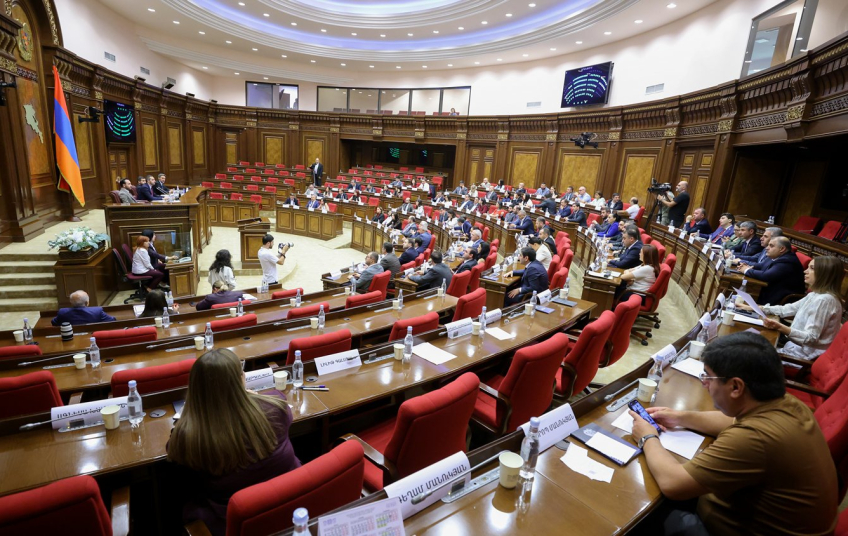

The National Assembly of the Republic of Armenia holds a central role in the country's governance, serving as its primary political stage and legislative body. It is often said that this is Armenia’s premier podium, a title that naturally carries immense responsibility and an honorable mission. Every statement and every word delivered from it should not only reflect a civilized and distinctly Armenian character, but also convey profound, truthful, and educational substance. Furthermore, upholding strict standards of integrity and proper conduct is an inseparable part of parliamentary culture. Unfortunately, during sessions of the National Assembly, this premier national stage is too often diminished by inappropriate remarks, unconstructive debates, and street slang.
Numerous attempts have been made to strengthen integrity standards within the National Assembly. Despite the work of special committees, organized knowhow exchanges, and extensive discussions, these efforts have consistently fallen short. Before long, old habits resurface, further eroding public trust in Parliament. Every five years, the faces at the podium change, yet the "time-honored" traditions of verbal brawls, profanity, and vulgarity remain entirely untouched. Under Nikol Pashinyan's administration, however, this behavior has reached an absolute peak, a decline to which his personal "contribution" has been undeniable.
No previous Armenian leader has spent as much time in Parliament as Pashinyan. Making every effort to attend every session of the National Assembly, he refuses to limit himself to brief appearances during question-and-answer sessions. If given the choice, he would dedicate the lion’s share of parliamentary time to using the nation’s highest podium as a personal marketing tool for the Civil Contract party and himself, vocalizing a fabricated sense of global prestige and glory. However, through a series of dramatic outbursts and unseemly statements, he frequently manages to humiliate not just himself, but the entire state.
By and large, Nikol Pashinyan represents the ex officio embodiment of integrity for Armenia and, indeed, for the entire Armenian people. By virtue of his office, he is expected to serve as a role model, a public figure whom citizens look up to and from whom they can learn dignity, impeccable speech, and proper conduct. At least, that is how it ought to be. Frankly speaking, however, Armenia has been unfortunate: Pashinyan is not a leader to emulate, least of all when it comes to integrity. Perhaps that is not entirely his fault. Integrity is not a trait one is simply born with or handed on a silver platter. It is shaped within the family, nurtured at school, and reinforced by the social environment that molds us all.
One could easily cite instances of unacceptable and offensive rhetoric from members of the current administration, certainly not all of them, including prime minister Pashinyan. Revisiting these terms is unnecessary, however, as they have been documented extensively and do not warrant further repetition. Notably, official appeals for political integrity are almost exclusively directed toward the opposition, despite the fact that MPs from the ruling faction are generally the ones provoking confrontations within the National Assembly.
The issue of codes of conduct in the National Assembly was further elaborated on by Mamikon Aslanyan, a member of the “Strong Armenia” faction, who stated that violations of integrity rules are more frequently committed by MPs from the Civil Contract party. In his view, it is not the newly elected opposition MPs who are poisoning the atmosphere in the National Assembly, since they grew up in educated and well-mannered families. “And if there is a need to call for integrity, then that appeal should first and foremost be addressed to Nikol Pashinyan,” the opposition MP noted. There can be no objection to this, it is a fact.
“Hayatsk Yerevanits” Journal