| |
May 27, 2004
ACNIS Releases Expert Poll Results,
Focus on Armenia in the World
Yerevan—The Armenian Center for National and International Studies (ACNIS) today convened a public roundtable to issue the results of its first two expert opinion surveys. Entitled "My View of Armenia's Future" and "Armenia's Foreign Policy, Orientation, and Attitude toward Power Centers of the World," they embrace vital issues of concern for both the Republic of Armenia and Armenians worldwide. The seminar brought together policy and academic circles, leaders of the NGO community, representatives of the mass media, politicians, public figures, and human rights advocates in order to consider specific trends and patterns in the specialized domain.
ACNIS founder Raffi Hovannisian greeted the audience with opening remarks. "Currently concluding its first decade of public service, the Center's research agenda this year will seek out the applied setting and the public pulse, expanding its field of observation to include the entire spectrum of society. In this manner we will develop the foundations required to compare today's expert viewpoints with prevailing public opinions, for a better and more comprehensive understanding of key issues facing the nation," Hovannisian said.

ACNIS legal and political affairs analyst Stepan Safarian then presented the results of the Expert Opinion Poll on "My View of Armenia's Future." In the foreseeable future, regional cooperation will be a priority issue for Armenia, assert 18% of the respondents. Almost an equal percentage prioritize establishment of democracy, of which 2% emphasize the restoration of constitutional order. 16% of the respondents attach primary importance to the settlement of the Karabagh matter. 10% prefer a reassessment of foreign policy, and 10% law and order in domestic life. For 8% of respondents, strengthening of the army and maintenance of internal stability each are ranked as the most urgent issue. 6% note the campaign against corruption, and 4% the creation of jobs, as the question of paramount importance.
|
Regulation of the Karabagh conflict
|
16%
|
|
Reassessment of Armenia’s foreign policy
|
10% |
|
Regional cooperation
|
18% |
|
Strengthening of the army
|
8% |
|
Maintenance of stability in the country
|
8% |
|
Establishment of law and order
|
10% |
|
Elimination of emigration
|
0% |
|
Campaign against corruption
|
6% |
|
Deepening of democracy
|
18% |
|
Job creation
|
4% |
|
Other: Restoration of constitutional order
|
2% |
|

|
In another connection, 68% of respondents believe the elimination of emigration to be plausible in the near future, while 56% find possible the regulation of the Karabagh conflict, 52% international recognition of the Armenian Genocide, and 52% poverty reduction. Only 6% have an optimistic view about the return of historical Armenian lands.
|
Possible
|
Impossible
|
|
International recognition of the Armenian Genocide
|
52%
|
48%
|
|
Return of historical Armenian lands
|
6%
|
94%
|
|
Resolution of Karabagh question
|
56%
|
44%
|
|
Elimination of emigration
|
68%
|
32%
|
|
Surmounting poverty
|
52%
|
48%
|
|
Campaign against corruption
|
6%
|
94%
|
|
Other
|
|
|
An equal percentage share a hope to succeed in the struggle against corruption. In the opinion of 80% of respondents, Armenia's prospects for sovereign democracy are endangered in the short run. This notwithstanding, 74% still believe that all challenges currently faced will be overcome.
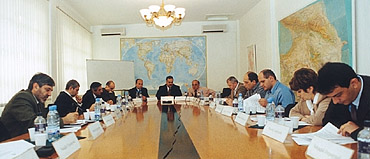
ACNIS international affairs associate and Yerevan State University professor Aram Harutiunian presented the results of the Expert Opinion Poll on "Armenia's Foreign Policy, Orientation, and Attitude toward Power Centers of the World." In his report, 56% of all respondents attach high significance to protection of human rights as the leading requirement to which the Council of Europe holds the Republic of Armenia, 34% to constitutional reforms, and 6% to judicial reforms.
|
Human rights protection, including
freedom of speech, conscience,
assembly, and press
|
56%
|
|
Constitutional reforms
|
34% |
|
Judicial-legal reforms
|
6% |
|
Other
|
4% |
|

|
82% are not satisfied with the level of Armenia's fulfillment of Council of Europe commitments, whereas 72% believe that it is the Council of Europe, together with the European Union, which promotes Armenia's independence.
|
Unsatisfactory
|
82%
|
|
Satisfactory
|
18% |
|

|
As for the states or international organizations circumscribing Armenia's independence, 56% of the respondents note the Russian Federation, 6% the United States and the World Bank, respectively, 4% Turkey, and so on. It is noteworthy that 12% cite the Armenian government as an obstacle to establishment of independent statehood.
|
None
|
10%
|
|
Turkey
|
4% |
|
USA
|
6% |
|
CIS
|
6% |
|
PACE and European Union
|
0% |
|
UN
|
0% |
|
Georgia
|
0% |
|
Iran
|
0% |
|
Azerbaijan
|
0% |
|
Other: Armenian government
|
12% |
|
International Monetary Fund,
World Bank
|
6% |
|
Russian Federation
|
56% |
|

|
66% of the specialists surveyed think that Armenia should join NATO within 10-12 years, and 6% of the remainder have difficulty in answering.
|
Yes
|
66%
|
|
Difficult to answer
|
6% |
|
No
|
28% |
|

|
18% consider the present deployment of Russian bases in Armenia the main guarantee for regional stability. 76% do not view the Russian military presence in Armenia as such a guarantee, and 6% encounter difficulty in responding to the question.
|
No
|
76%
|
|
Yes
|
18% |
|
Difficult to answer
|
6% |
|

|
Fifty experts of various ages and both genders took part in the expert opinion poll. 30% of them work at state-run and 70% in non-governmental institutions; 72% are male, and 28% female. 18% are 20-30 years old, 40% 31-40, 32% 41-50, 6% 51-60, and 4% 61-70 years of age. 98% of the responding specialists have received higher education. 32% are candidates of science (PhD), 2% of whom are full professors, 60% hold a Master's degree, while 6% have earned solely a Bachelor's degree.
|
20-30
|
31-40
|
41-50
|
51-60
|
61-70
|
|
18%
|
40%
|
32%
|
6%
|
4%
|
|
Higher
|
Incomplete higher
|
Secondary specialized
|
Secondary
|
|
98%
|
2%
|
0%
|
0%
|
|
Full professor
|
Candidate of science
|
Master’s
|
Bachelor’s
|
|
2%
|
32%
|
60%
|
6%
|
|
State-run
|
Non-governmental
|
|
30%
|
70%
|
The presentations were followed by contributions by Yerevan State University sociology professor Zinaida Tokmajian; "Yerkir" weekly's editor-in-chief Spartak Seiranian; American University international relations professor Khachik Derghoukassian; European Union Chamber of Commerce executive director Hovhannes Igityan; Armenian European Policy and Legal Advice Center executive director Tigran Jrbashian; Avetik Ishkhanian of the Armenian Helsinki Committee; Sevak Lalayan of the International Center for Human Development; Armen Aghayan of the "Protection of Liberated Territories" public initiative; and many others.
Founded in 1994 by Armenia’s first
Minister of Foreign Affairs Raffi K. Hovannisian, and supported
by the Lincy Foundation and a global network of contributors,
ACNIS serves as a link between innovative scholarship and the public
policy challenges facing Armenia and the Armenian people in the post-Soviet
world. It also aspires to be a catalyst for creative,
strategic thinking and a wider understanding of the new
global environment. In 2004, the Center focuses primarily on public
outreach, civic education, and applied research on critical domestic
and foreign policy issues for the state and the nation.
For further information on the Center and its activities,
call (37410) 52-87-80 or 27-48-18; fax (37410)
52-48-46; e-mail root@acnis.am or info@acnis.am
|
|