| |
September 30, 2005
ACNIS Polls Target Armenia’s Regional and Communal Development
Yerevan—The Armenian Center for National and International Studies (ACNIS) today convened a policy roundtable to sum up the results of the two public surveys it simultaneously conducted in September on local development and governance perceptions in Yerevan and all Armenia. 1000 respondents from all regions of Armenia except the capital participated in the first poll, while 500 Yerevan residents took part in the second.
ACNIS director of research Stiopa Safarian greeted the audience with opening remarks and made a comparative analysis of the two polls. According to their findings, there is a marked difference between the socioeconomic development of Yerevan and that of the remaining regions. Accordingly, 50.3% of the respondents living in the regions find this disparity to be very significant, 35.2% significant, and only 11.3% insignificant. The results among Yerevan residents are 49.6%, 40%, and 8.2% respectively, fairly close to the opinions of the first group of respondents.

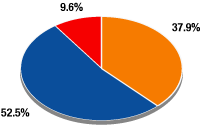
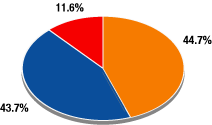
It is unfortunate that people living both in the regions and in Yerevan have a desire to move away from their permanent places of residence: 44.7% of regional respondents and 37.9% of those living in Yerevan express such an inclination. The percentage of those who do not want to leave constitutes 43.7% in the regions and 52.5% in the capital city.
| Difficult to answer |
11.6% |
|
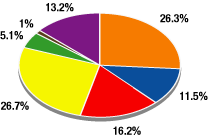
Of interest is that whereas a plurality, namely 15.4%, of those who want to move from the regions prefer Yerevan as their new destination, most Yerevan dwellers have their sights set abroad, particularly the United States at 8.6%, Russia 7.8%, and Europe 5.8%. The other peculiarity refers to the causes for leaving their places of habitation. Among the respondents from the regions the primary reasons are unfavorable living conditions and unemployment, 48.1% for each. For 45.1% of capital residents it is the uncertainty of their future, though 44% of them also point to unfavorable living conditions and 30.1% to unemployment. This notwithstanding, an almost equal preponderance of the two respondent groups, more than 70%, is convinced that finding a job and earning money is much easier in Yerevan than in the regions. According to the surveys, agriculture, at 48.1%, has the greatest development potential in the regions, while in Yerevan it is trade and commerce with a result of 26.7%.
|
Service sector (hotel, restaurant business, entertainment, etc) |
16.2% |
| Other |
1% |
- Science
- Construction
- Prostitution
|
|
| Difficult to answer |
13.2% |
|
As indicated by 47.1% of the respondents living in the regions, the most promising branch of agriculture in their place of residence is farming, followed by cattle breeding at 29.4%, agricultural products 22.4%, small cattle breeding 19.7%, and beekeeping 9.6%.
1. |
Cattle breeding |
29.4% |
2. |
Small cattle breeding |
19.7% |
3. |
Poultry farming |
8.2% |
4. |
Agriculture (vegetable growing, gardening, vineyards) |
47.1% |
5. |
Tobacco farming |
3.1% |
6. |
Beekeeping |
9.6% |
7. |
Forestry |
4.9% |
8. |
Fishing |
2.4% |
9. |
Agricultural products |
22.4% |
10. |
Difficult to answer |
13.9% |
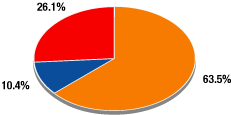
It also is noteworthy that the participants of both surveys favor the election of local community leaders. To the question “Would you like to elect your regional governor?,” 63.5% of regional participants respond in the affirmative, with 10.4% opposed.
| Difficult to answer |
26.1% |
|
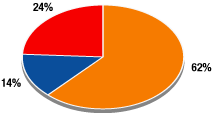
Regarding a corresponding query on election of the mayor of Yerevan, 62% of capital residents say “yes” and 14% “no.”
The questionnaires make it clear that only 22.8% of the respondents from the regions are satisfied with the activities of their community leaders, whereas in Yerevan this rating is a mere 19.2%. On the contrary, 49.6% and 50.6% respectively are dissatisfied with the work carried out by the person in charge of their community. Even more, a large percentage has no confidence whatsoever in its community leader. 45.6% of the republic-wide respondents maintain that their regional governor impedes the development of the region or has no role in it at all, and 60.5% of survey participants from the capital city say the same of their mayor. On the matter of the current territorial-administrative division of Armenia’s regions, 40.5% of the first and 24.6% of the second respondent groups express discontentment over the regional layout.

During his policy intervention on contemporary problems facing local government, prefect Davit Petrosian of the Nor Nork district of Yerevan brought forth the example of his own neighborhood and highlighted recent institutional changes, such as the collection of property tax by the boroughs, which have increased the community budget and solved many problems. “The relationship between community bodies and condominia needs legislative clarification. It is also necessary that jurisdiction over the schools be transferred over to the communities, and empowerment of the councils of elders be further elucidated and enlarged,” Petrosian said.
In his address, deputy chairman Davit Tumanian of the Association of Community Financists talked about the prospects for improving local administration in Armenia. “Overall, this domain is legislatively regulated, but it requires further fine-tuning. In order to consolidate the local government system, it is indispensable for the National Assembly to adopt a strategy for decentralization.”
The formal interventions were followed by contributions by Sos Gimishian from the Association of Community Financists; chairman Aram Grigorian of the Association of Condominium Presidents; analyst Hripsime Manukian from the Poverty Reduction Strategy Paper Monitoring and Assessment working group; chairman Aram Mailian of the Political Discussion Club; analyst Armen Galstian from the International Center for Human Development; lecturers Vilik Yedigarian and Haik Chilingarian from the Academy of Public Administration; analyst Gor Hakobian of the Institute for Democracy and Human Rights; ACNIS analysts Syuzanna Barseghian and Hovhannes Vardanian; National Citizens’ Initiative coordinator Hovsep Khurshudian, activists Gohar Isakhanian and Armen Martirosian; and several others.

Among the respondents from the regions 9.3% are 16-20 years old, 25.4% 21-30, 22.9% 31-40, 20.2% 41-50, 10.4% 51-60, 7.1% 61-70, and 2.6% 71 and above. 45.7% are male and 54.3% are female. Among them 31.8% have received higher education, 10.6% incomplete higher education, 24.6% secondary specialized, 29.4% secondary, and 3.2% have incomplete secondary education. 44.6% are employed, 34.8% unemployed, 11.5% are pensioners and welfare recipients, and 8.8% are students.
In the Yerevan poll, 13.3% are 16-20 years old, 30% 21-30, 15.6% 31-40, 21.7% 41-50, 11.6% 51-60, 4.6% 61-70, and 2.2% 71 and above. 40% are male and 60% are female. Among them 49.2% have received higher education, 13.2% incomplete higher education, 16.4% secondary specialized, 17.6% secondary, and 3.2% have incomplete secondary education. 54% are employed, 24.6% unemployed, 8.2% are pensioners and welfare recipients, and 12% are students.

Founded in 1994 by Armenia’s first Minister of Foreign Affairs Raffi K. Hovannisian and supported by a global network of contributors, ACNIS serves as a link between innovative scholarship and the public policy challenges facing Armenia and the Armenian people in the post-Soviet world. It also aspires to be a catalyst for creative, strategic thinking and a wider understanding of the new global environment. In 2005, the Center focuses primarily on civic education, conflict resolution, and applied research on critical domestic and foreign policy issues for the state and the nation.
For further information on the Center and its activities,
call (37410) 52-87-80 or 27-48-18; fax (37410)
52-48-46; e-mail root@acnis.am or info@acnis.am
|
|