| |
April 26, 2005
ACNIS Roundtable on Public Opinion and the Armenian Genocide
Richard Hovannisian Keynotes
Yerevan—The Armenian Center for National and International Studies (ACNIS) today released the results of a public survey on “The Armenian Genocide: 90 Years and Waiting” which it conducted among 1900 citizens from Yerevan and all of Armenia’s regions.
ACNIS founder Raffi K. Hovannisian invited the participants to stand in a moment of silence for the one and a half million victims of the Armenian Genocide and the millennial homeland of which they were brutally dispossessed. “These 90 years could not make the Armenian nation forget this defining calamity, nor did they relieve the deep pain of the Genocide survivors and all Armenians the world over. The day will come when the civilized world condemns the Armenian Genocide, and Turkey too will recognize its crime against humanity. The current domain of European integration offers a pivotal chance for Armenia and Turkey to enter the European family together, having solved all outstanding issues, including the watershed legacy of the Genocide, and thus opened a new page in Armenian-Turkish relations. Justice at home, justice in the world—this should be the standard for Armenia’s and its people’s quest,” Hovannisian said.

Professor Richard G. Hovannisian, Chairholder of Modern Armenian History at UCLA, delivered keynote remarks on “The Enduring Legacy of the Armenian Genocide.” Reflecting on a variety of challenges in the modern academic world relating to the Armenian Genocide, Hovannisian underscored that all serious scholars, both Armenian and foreign, and even several Turkish intellectuals, share the same conclusions, though with different interpretations, that the Armenian Genocide is an historical fact and undeniable reality. “According to the prevailing approach in academic circles, the Armenian Genocide was truly planned and premeditated, and a mere opportunity was needed to launch it. World War One provided such a cover,” Professor Hovannisian noted, demonstrating that after Ottoman Turkey lost its European territories in the Balkan wars, its primary response was the expulsion of all Armenians from their homeland in Asia Minor and their settlement by Turks. Before the 1915 final solution, there already was in place a state program of reducing the proportion of the Armenian population in each of its historic regions to 5-10 percent, which was then methodically implemented as genocide.
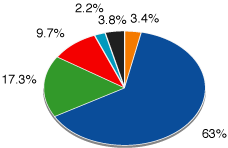
ACNIS research coordinator Stepan Safarian focused in detail on the findings of the opinion poll. Accordingly, 44.7% of surveyed citizens nearly always have participated in Genocide commemorations in their mature life, 42.5% sometimes, and only 9.8% have never participated in them. As for the motivation for going to Tsitsernakaberd or other memorials on April 24 every year, 63% find that it is their duty to respect the memory of the martyrs, 17.3% want to show the world that Armenians do not forget their history, whereas 9.7% think it is a way of protesting against Turkish denial of the fact of Genocide. For 3.4% of citizens it is merely a long-standing tradition, for 0.3% just an occasion to go for a walk, and 3.8% do not go anywhere that day.
|
It is a long-standing tradition |
3.4% |
| It is my duty to respect the memory of the martyrs |
63% |
|
It is a way of showing the world that the Armenians do not forget their history |
17.3% |
| It is a way of protesting against Turkish denial of the fact of Genocide |
9.7% |
|
It is a way of perpetuating national identity |
2.2% |
| I do not go anywhere |
3.8% |
|
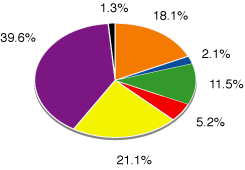
Hence, 95% of respondents assert it is very important to mark that day with a national commemoration every year, while it does not matter much for 4.2% and is not important at all for 0.5%. 39.6% of citizens feel pain when thinking about the Armenian Genocide, 21.1% revenge, 18.1% hatred, 11.5% enmity, 5.2% sympathy for the victims, and 2.1% have a sense of guilt.
| Other |
0.8% |
- Incapability
- Sobriety
- Obligation
- Readiness to forgive
- Will to live
- Will to unite, win, and redeem
- None
|
|
|
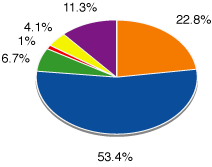
64.7% consider the human loss of the Genocide to be the biggest, 34.1% believe it to be the territorial loss of homeland, 18% the nation’s loss of spirit and will, and 15.4% loss of the pre-Genocide intelligentsia.
|
Territorial (A major part of the historical homeland) |
22.8% |
|
Who is first and foremost responsible for the Armenian Genocide? In response to this question, 61.1% accuse the Turkish state in its entirety, 54.8% the Young Turk government, 23.1% the Turkish people, 29.7% Germany, 13.4% the Russian Empire, 10% traditional Armenian parties, 6.5% the entire Armenian people, 6.2% Great Britain, and 5.2% Jews.
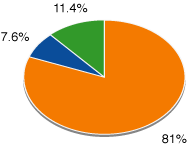
62.6% of surveyed citizens think that “a Turk remains a Turk, always capable of committing genocide,” 6.9% are of the opposite opinion, and 28.9% believe that Turkey’s governmental policies are one thing but its average citizens another. 81% are convinced that today’s Republic of Turkey is accountable for the Genocide, 7.6% assert the contrary, with 11.4% finding it hard to answer.
| Difficult to answer |
11.4% |
|
72.9% trust that Turkey will recognize the Genocide in the next five to ten years if the international efforts of Armenia and the Diaspora for recognition are activated and/or the United States and the European Union exert stronger pressure on Turkey. 12.8% think this to be impossible, and 14% have difficulty answering.
93.5% hold that Armenia should claim reparations from Turkey; 67.7% of these expect official acknowledgment and apology, education, and removal of all forms of denial, 60.7% return of territories in Western Armenia, 44.1% financial reparations to the heirs of the victims.

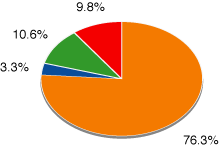
It is noteworthy that 39.8% agree with Armenia’s current posture toward Turkey, 29.1% do not agree, and 31.1% find it difficult to answer. Nonetheless, a clear majority (76.3%) believe that the Armenian side should establish relations with Turkey without forgetting the past.
|
Establish relations without forgetting the past |
76.3% |
|
Establish relations without remembering the past |
3.3% |
|
Not establish relations |
10.6% |
|
51.8% are against Turkey’s accession to the European Union, 25.2% are in favor of it, and 23% do not give a firm response.
The formal interventions were followed by contributions by National Academy of Sciences Vice President Vladimir Barkhudarian; professors Babken Harutiunian, Khoren Palian, and Vardan Khachatrian of Yerevan State University; Sonia Mirzoyan of the Armenian National Archives; Giro Manoyan of the Armenian Revolutionary Federation; Edgar Martirosian of UCLA; Tigran Matosian of the Museum-Institute of the Armenian Genocide; Taline Papazian of the Paris Institute of Political Sciences; National Press Club chairperson Narine Mkrtchian; Armen Aghayan of the “Protection of Liberated Territories” public initiative; Noyan Tapan News Agency political analyst Davit Petrosian; and several others.

42.5% of respondent citizens participating in the ACNIS poll are male and 57.5% female; 14.7% are 16-20 years of age, 20% 21-30, 20.8% 31-40, 22.2% 41-50, 13.5% 51-60, 6.1% 61-70, 2% 71 or above. 47.1% of them have received a higher education, 13.1% incomplete higher, 18.4% specialized secondary, 15.3% secondary, and 1.9% incomplete secondary training. 54.8% are actively employed and 19.8% unemployed, 7.2% are pensioners and welfare recipients, and 15.4% students. Urban residents constitute 65.2% of the citizens surveyed, while rural residents make up 34.8%. 32% of all respondents hail from Yerevan, and the rest are from outside the capital city.
Founded in 1994 by Armenia’s first Minister of Foreign Affairs Raffi K. Hovannisian and supported by a global network of contributors, ACNIS serves as a link between innovative scholarship and the public policy challenges facing Armenia and the Armenian people in the post-Soviet world. It also aspires to be a catalyst for creative, strategic thinking and a wider understanding of the new global environment. In 2005, the Center focuses primarily on civic education, conflict resolution, and applied research on critical domestic and foreign policy issues for the state and the nation.
For further information on the Center and its activities,
call (37410) 52-87-80 or 27-48-18; fax (37410)
52-48-46; e-mail root@acnis.am or info@acnis.am
|
|