| |
March 4, 2005
ACNIS Releases Public Opinion Results
on Constitutional and Election Code Reforms
Yerevan—The Armenian Center for National and International Studies (ACNIS) today issued the results of a public poll on “Constitutional and Electoral Reforms” which it conducted in February among 1500 citizens from Yerevan and all of Armenia’s regions.

ACNIS founding director Raffi Hovannisian greeted the invited guests and public participants with opening remarks. “I trust this first survey of the year will provide a solid basis for interpreting and evaluating Armenian public attitudes toward democratic values and for clarifying citizen perceptions of key constitutional and electoral issues,” Hovannisian said.
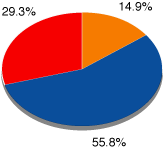
ACNIS research coordinator Stepan Safarian focused in detail on the findings of the opinion poll. Accordingly, a majority of surveyed citizens (70.7%) is completely or partially familiar with the content of the Armenian Constitution, while 29.3% are not familiar at all.
29.5% of those who are more or less familiar with the provisions of the Constitution think that whatever is written in it is not implemented at all, 46.5% believe it to be partially implemented, and only 2.3% completely implemented, with 21.5% finding it difficult to answer.
|
Whatever is written in the Constitution is being completely implemented |
2.3% |
|
Whatever is written in the Constitution is being partially implemented |
46.5% |
| Nothing is being implemented |
29.5% |
| Difficult to answer |
21.5% |
|

|
38.5% of participating citizens are of the opinion that the Constitution needs reform, 10.4% feel the necessity for a new Constitution, whereas 38.8% conclude that more important than reforms is the systematic implementation of its existing provisions.

As for society’s expectations from the constitutional reforms, 37.1% of citizens expect expansion of human rights and improvement of constitutional guarantees for their protection, 3.9% the opposite, that is restriction of human rights and freedoms, 14.4% clarification of relations among the president, parliament, government, and judicial branch of power, 10.9% limitation of the president’s prerogatives, 8.2% raising the role of the National Assembly, 8.7% stipulation of mechanisms for the real independence of judicial authority, 4.5% raising the self-sufficiency of local government, and 7.2% fulfillment of Armenia’s commitments before the Council of Europe. 26.2% have no expectations, and 9.7% find it difficult to answer.
|
Expansion of human rights and improvement of constitutional guarantees for their protection |
37,1% |
|
Restriction of human rights and freedoms |
3,9% |
Clarification of relations among the president, parliament, government,
and judicial branch of power |
14.4% |
| Limitation of president’s prerogatives |
10.9% |
| Raising the role of the National Assembly |
8.2% |
| Stipulation of mechanisms for real independence of judicial authority |
8.7% |
|
Raising the self-sufficiency of local government |
4.5% |
|
Fulfillment of Armenia’s commitments before the Council of Europe |
7.2% |
|
I have no expectations |
26.2% |
|

|
| Note: The respondents were given the opportunity to choose two answers. Hence the indices do not total 100%. |
11.6% of respondents prefer a presidential system of government, 7.7% a parliamentary system, and 16.7% a semi-presidential one, whereas 51.7% think what is most important is democracy. 5.6% of citizens opine that the prime minister should be appointed by the president without the National Assembly’s consent, 14.9% by the National Assembly without the president’s consent, 24.9% by the president with the National Assembly’s consent, and 20.9% by the National Assembly with the president’s consent. As for the dissolution of parliament, 13% of the respondents assert that the president should retain the right to dissolve it and call new elections, 42.5% think it should be dissolved only by referendum held by demand of a certain number of voters, and 15.5% are generally against its dissolution. 25.1% of citizens are convinced that courts will be just and impartial if judges are elected by the people, 8.3% if the National Assembly appoints and dismisses judges, and but 4% if the president appoints and dismisses them.

Among the surveyed public, 26.7% consider presidential elections to be most important, 6.3% parliamentary polls, and 3.5% municipal elections, with 46.6% finding all of them to be equally significant. 17.9%, however, say they have not taken part in the elections of recent years. 15% of these are not interested in politics, 35.2% have abstained because of falsifications, and 11.3% are convinced that no candidate deserved to be elected. 40.9% hold that the results of the 2003 presidential elections raise the most doubts from the point of view of their legitimacy, 24.8% cite the elections of 1996, and 22.2% those of 1998, while 33.6% maintain that they are equally untrustworthy. A plurality (38.9%) of responding citizens asserts that the most unfair parliamentary elections were held in 2003. As for local elections, 4.7% think the 1996 results are the most suspect, 6.4% those of 1999, and 16.7% those of 2002.
Presidential elections |
Parliamentary elections |
Local elections |
| 1991 |
1.8% |
1990 |
1.5% |
1991 |
4.7% |
| 1996 |
24.8% |
1995 |
13.7% |
1999 |
6.4% |
| 1998 |
22.2% |
1998 |
16.4% |
2002 |
16.7% |
| 2003 |
40.9% |
2003 |
38.9% |
All of them and equally |
48.1% |
| All of them and equally |
33.6% |
All of them and equally |
37.9% |
None |
19.1% |
| None |
6.8% |
None |
7.9% |
Refused to answer |
8.3% |
| Refused to answer |
3.1% |
Refused to answer |
7% |
|
|
| Note: The respondents were given the opportunity to choose three answers in the first and second categories, two in the third. Hence the indices do not total 100%. |
As for the major factor influencing elections held in Armenia, 39.9% pinpoint money, 36.8% pro-incumbent administrative levers, 6.9% the mass media, 4.3% the candidate’s ideological and party belonging, and only 5.7% the candidate’s personal characteristics.
|
Administrative levers (abuse of position by officials) |
36.8% |
| Television, radio, press |
6.9% |
| The candidate’s ideological and party belonging |
4.3% |
The candidate’s personal characteristics
|
5.7% |
| |
- The voters’ lack of knowledge about their rights
- The institution of “local bosses”
- The candidate’s entourage
|
|
|
|

|
51.4% of citizens believe that elections will be freer and fairer if the army is deprived of the right to vote. Nonetheless, there also are other ways of reducing election falsifications. 21.4% think elections will not be falsified or will be falsified in smaller measure if the election commissions represent equally all the parties competing in the electoral process, 18.1% if commissions are composed not of political party representatives but of neutral specialists, 18.8% if the commission head or certain members are appointed by international observation missions, and 17.3% if the president does not possess the prerogative to appoint commission members. The second item on the day’s agenda was a presentation by Constitutional Court Justice Felix Tokhian on “Securing Constitutional and Electoral Rights in the Armenian Reality.” “The ideology of the current Constitution is intended to ensure the country’s governability, but it should instead be focused on citizens’ rights, that is the establishment of democratic precepts,” he underscored.

An alternative conception on the constitutional and electoral code reforms was presented by Grigor Ghonjeyan of the United Labor Party. He detailed the controversial provisions of the reform draft proposed by his party, referring particularly to the impermissibility of depriving people of citizenship, the manner of alienating property, the role of the church, the ban on dual citizenship, and the functions of the branches of power. “We have been guided by the principle of making the human being the axis of the Constitution,” he emphasized.
“To what extent have the suggestions of the Venice Commission been taken into account?” Political scientist and constitutional lawyer Vardan Poghosian reflected on the two drafts proposed by the governing coalition and the United Labor Party, underlining the importance of clarifying the president’s constitutional-legal status as well as the relations between president and government, government and parliament. “The president should not have the prerogative to dismiss the prime minister, as he is not the head of the executive branch under the current system,” he said, adding that the president’s authority should be limited to guaranteeing the country’s defense capacity and national security. In his opinion, the constitutional reforms should be based on the draft of 2001 approved by the Venice Commission.
The formal interventions were followed by contributions by former Prime Minister Khosrov Harutiunian of the Christian Democratic Party; former presidential adviser Levon Zurabian; Ruben Torosian of the Human Rights-Democracy Party; Noyan Tapan news agency political analyst Davit Petrosian; Albert Baghdasarian of the National Democratic Union; Petros Makeyan of Democratic Fatherland; lawyer Norair Yeghiazarian; and several others.

47.2% of respondents participating in the ACNIS poll are male and 52.8% female; 7.2% are 17-20 years of age, 24.8% 21-30, 23.1% 31-40, 22.8% 41-50, 14.2% 51-60, 7.1% 61-70, and 0.8% 71 or above. 44.4% of them have received a higher education, 12.8% incomplete higher, 20.5% specialized secondary, 16% secondary, and 2.3% incomplete secondary training. 58.3% are actively employed and 23.9% unemployed, 5.2% are pensioners, 1.7% welfare recipients, and 10.7% students. Urban residents constitute 61.9% of the citizens surveyed, while rural residents make up 38.1%. 30.7% of all respondents hail from Yerevan, and the rest are from outside the capital city.
Founded in 1994 by Armenia’s first
Minister of Foreign Affairs Raffi K. Hovannisian, and supported
by the Lincy Foundation and a global network of contributors,
ACNIS serves as a link between innovative scholarship and the public
policy challenges facing Armenia and the Armenian people in the post-Soviet
world. It also aspires to be a catalyst for creative,
strategic thinking and a wider understanding of the new
global environment. In 2005, the Center focuses primarily on civic education, conflict resolution, and applied research on critical domestic
and foreign policy issues for the state and the nation.
For further information on the Center and its activities,
call (37410) 52-87-80 or 27-48-18; fax (37410)
52-48-46; e-mail root@acnis.am or info@acnis.am
|
|