| |
July 1, 2005
ACNIS Releases Public Perceptions
on Armenia’s Regional Role
Yerevan—The Armenian Center for National and International Studies (ACNIS) today convened a policy roundtable on “The South Caucasus: Common or Separate Destinies?” to issue the results of both a public survey and a specialized questionnaire on “Armenia’s Place and Role in the Region” conducted among 40 experts and 1500 citizens from Yerevan and all of Armenia’s regions. The meeting brought together policy analysts, experts, public figures, academic circles, media and NGO representatives to discuss public perceptions and expert views regarding the Caucasus, the spheres in which Armenia might play a leading role among neighboring countries, and on the whole the nation’s strengths and weaknesses, influences, and preferable systems of security.
ACNIS director of administration Karapet Kalenchian greeted the invited guests and public participants with opening remarks. “The strategically miscalculated, situational foreign policy that the administration pursues is directly related with Armenia’s shortcomings in the domestic political, socio-economic, and spiritual-cultural spheres. The country cannot be strong and defend its own interests in the region as long as the gap between the authorities and the people keeps growing.”
ACNIS analyst Syuzanna Barseghian focused in detail on the findings of the opinion polls. Accordingly, 95.7% of the surveyed citizens and 97.5% of experts hold that Armenia has issues of dispute with Azerbaijan, 94.4% and 97.5% respectively with Turkey, 62.2% and 67.5% with Georgia, even 19.9% and 15% with Iran and 18% and 47.5% with Russia. It is noteworthy that approximately half of the specialists mention a problematic relationship with Russia.

Of the three South Caucasus countries listed, which one enjoys the most solid position in relative terms? 34.8% of polled citizens assert that Armenia has the soundest position in domestic policy or democracy, 22.3% note Georgia and 5.9% Azerbaijan, whereas most experts maintain quite an opposite view in this respect. 70% of them believe that Georgia is the democratic leader of the region, whereas Armenia comes in ten times behind the cradle of the “rose revolution” and Azerbaijan marks zero. 37% of respondent citizens and 22.5% of experts find it difficult to answer.
| Sphere |
Armenia |
Azerbaijan |
Georgia |
Difficult to answer |
| Domestic Policy (Democracy) |
7.5% |
0% |
70% |
22.5% |
| Foreign Policy (Diplomacy) |
5% |
12.5% |
77.5% |
5% |
| Economy |
10% |
60% |
5% |
25% |
| Defense (Army) |
80% |
5% |
5% |
10% |
| Education, Science |
35% |
5% |
10% |
50% |
| Culture |
32.5% |
2.5% |
25% |
40% |
| Sphere |
Armenia |
Azerbaijan |
Georgia |
Difficult to answer |
| Domestic Policy (Democracy) |
34.8% |
5.9% |
22.3% |
37% |
| Foreign Policy (Diplomacy) |
31.2% |
21.8% |
16% |
31% |
| Economy |
22.2% |
29.8% |
9.1% |
38.9% |
| Defense (Army) |
70.7% |
3.7% |
2.4% |
23.2% |
| Education, Science |
64.5% |
1.2% |
2.6% |
31.7% |
| Culture |
58% |
1.2% |
7.4% |
33.4% |
In evaluating the strongest position in foreign policy, there is considerable divergence in the viewpoints of the two groups. Only 31.2% of citizens and 5% of experts offer a response in Armenia’s favor. An overwhelming majority of experts, 77.5%, duly assess Georgia’s external policy. In the case of Azerbaijan, the indices are 21.8% and 12.5%, respectively. It is only in the economic domain that 29.8% of citizens and 60% of experts consider Azerbaijan to have the most advantageous position. 70.7% and 80% of the respective groups find that Armenia has earned the leading place in defense matters. Both groups of respondents share the same opinion regarding the arenas of education and science. 64.5% and 35%, respectively, consider that sphere to be a priority issue for Armenia, 1.2% and 5% for Azerbaijan, and 2.6% and 10% for Georgia. Both groups attach high importance to culture in Armenia, though 33.4% of citizens and 40% of experts find this area difficult to gauge.
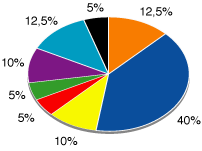
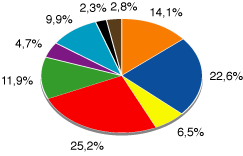
The fourth query on the poll’s list was the leading role Armenia can play in the region. 14.4% and 12.5% of the responding groups believe that Armenia has a greater role in comparison with Azerbaijan and Georgia in terms of democracy, 22.6% and 40% in advanced technologies, 6.5% and 10% in industry, 11.9% and 5% in agriculture, 25.2% and 5% in tourism, 4.7% and 10% in the financial sector, and 9.9% and 12.5% in regional communications and transportation.
|
Advanced technologies leader |
40% |
|
Developed industrial country |
10% |
|
Financial-banking center |
10% |
|
Main transit artery for communication and transportation |
12.5% |
|
|
Advanced technologies leader |
22.6% |
|
Developed industrial country |
6.5% |
|
Agricultural country |
11.9% |
|
Financial-banking center |
4.7% |
|
Main transit artery for communication and transportation |
9.9% |
| Other |
2.3% |
- Armenian Genocide
- Armenian-Turkey border
- Lack of unity of the Armenian people
|
|
|
Notwithstanding Armenia’s possible success in the aforementioned fields, there still are factors by which other countries influence Armenia. Thus, 57% of each respondent category assert that the main such factor is the Karabagh conflict, 13.3% and 11.8% point to the Russian military bases in Armenia, while 20.5% and 21.9% note Armenia’s external debt, 26.9% and 24.9% its illegitimate authorities, 18.3% and 19.2% the violation of democratic values, and 10.8% and 12% the Armenian nuclear power plant. The public and expert dispositions are strikingly similar in this connection.
Amid the three countries of the South Caucasus, Russia has the most influence upon Armenia, according to 58.9% and 85% of the responding groups, with the United States garnering 11.3% and 12.5% and the European Union 17.4% and 0%. In Azerbaijan, Russian influence musters 12.7% and 10%, American influence 40.9% and 57.5%, and European influence 15% and 5%. Georgia provides a different picture. There the most influential power is considered the United States by a vast majority of both citizens and experts—67.3% and 95% respectively. In the opinion of 6.3% and 0% the most influential is Russia, and 5.8% and 5% contemplate the EU.

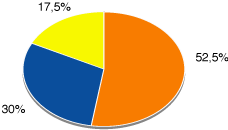
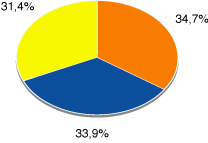
On the cause-effect example of the Baku-Tbilisi-Ceyhan oil pipeline, the poll participants deem variously that Armenia’s isolation would further deepen (48.2% and 65%), the region’s stability and development would be secured (9.6% and 10%), Azerbaijan would solve the Karabagh problem in its favor (9.1% and 0%), and resumption of an Armenian-Azerbaijani war would be ruled out (4.9% and 17.5%). If Armenia’s isolation really does deepen, then the question of consolidating the country’s security system would imperatively be begged. Is NATO the answer? In face of this choice, the views of ordinary citizens and the expert pool differ somewhat. While 34.7% of public respondents favor and 33.9% oppose Armenia’s membership in NATO, the majority of experts (52.5%) support such a move with 30% in disagreement.
| Difficult to answer |
17.5% |
|
| Difficult to answer |
31.4% |
|
The next item on the day’s agenda was a policy intervention, entitled “The Region within Old and New Geopolitical Strategies: A View from Armenia,” by ACNIS research coordinator Stepan Safarian. Sharing his outlook for the region in terms of possible political, economic, and demographic developments, Safarian concluded: “No matter how unique or different or competitive the histories of the people of the South Caucasus are, it is all the same; in all the Euroatlantic strategies being carried out in the region today, it is considered as one entity.”
This comment was followed by contributions by Liberal Progressive Party official Edward Antinian, MP Alexan Karapetian, ACNIS analyst Alvard Barkhoudarian, former minister of state Vahan Shirkhanian, Slavonic University professor Rozalina Gabrielian, Heritage Party board member Hrach Hakobian, International Center for Human Development executive director Tevan Poghosian, Noyan Tapan News Agency analyst Davit Petrosian, Noravank Foundation director Gagik Ter-Haroutiunian, and several others.
11.3% of the respondent citizens participating in the ACNIS poll are between the ages of 16-20, 23.1% 21-30, 22.7% 31-40, 24.3% 41-50, 10.3% 51-60, 5.3% 61-70, and 2.3% are above 71 years of age. 46% of the respondents are male and 54% female. 42.1% of them have higher education, 12.9% incomplete higher, 20.4% specialized secondary, 21.5% secondary, and 3.1% have incomplete secondary training. 57.2% are actively employed and 21.8% are unemployed. 8.2% are pensioners and welfare recipients, while 12.2% are students. Urban residents constitute 61.6% of the citizens surveyed, while rural residents make up 38.4%. 30.1% of all respondents hail from Yerevan and the rest are from outside the capital city. 
The primary occupation of 24.4% of those professionals who took part in the specialized poll is journalism, with 12.3% each for history and law, 9.8% each for political science, philology and physics, 4.8% each for economics and international relations, and 2.4% each for construction engineering, geography, and mathematics. 72.5% of the experts are male and 27.5% female. 17.2% are 20-30 years of age, 24.4% 31-40, 36.5% 41-50, 19.5% 51-60, while 2.4% are 61-70 years of age. 97.5% have received a higher education; 5.7% of them are Doctors of Science (PhD), 14.3% hold a Candidate’s degree, 77.1% a Master’s degree, and 2.9% only a Bachelor’s degree. All of them are from Yerevan.
Founded in 1994 by Armenia’s first Minister of Foreign Affairs Raffi K. Hovannisian and supported by a global network of contributors, ACNIS serves as a link between innovative scholarship and the public policy challenges facing Armenia and the Armenian people in the post-Soviet world. It also aspires to be a catalyst for creative, strategic thinking and a wider understanding of the new global environment. In 2005, the Center focuses primarily on civic education, conflict resolution, and applied research on critical domestic and foreign policy issues for the state and the nation.
For further information on the Center and its activities,
call (37410) 52-87-80 or 27-48-18; fax (37410)
52-48-46; e-mail root@acnis.am or info@acnis.am
|
|